
Deciphering the rules of aaRS interaction with tRNA 3' ends and genetic code maintenance
All known organisms in the biosphere utilize a 3' CCA end on their tRNAs, and until recently, it was believed that aminoacyl tRNA synthetases (aaRSs) require this sequence for successful aminoacylation of tRNAs. In parallel, it has been established that the 23S rRNA within the ribosomal large subunit interacts with the CCA bases through Watson-Crick base pairing. We discovered that natural aaRSs can tolerate complete alteration of the CCA end, which means that if complementary mutations are present in ribosomes, tRNAs with alternative anticodons could be accommodated in translation. (Radford et al., 2026).

Research Projects & Contributions
Automated engineering of genetic codes and translation systems
The genetic code provides the mapping between nucleotide sequences and the chemical building blocks of proteins, but conventional approaches to rewriting this mapping can require extensive genome engineering and long optimization cycles. We developed automated and multiplexed approaches to profile tRNA aminoacylation and used these capabilities to identify and engineer orthogonal translation systems. I then developed AGENTEX, a platform for rapid prototyping of genetic codes and evolution of biopolymers containing multiple instances of non- natural monomers. This work establishes an automated route for exploring alternative genetic codes and expands the toolkit for engineering biological systems with new chemical capabilities (Radford et al., 2026).
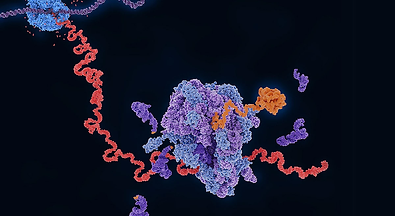
Image published in magazine article about our work:
https://cen.acs.org/biological-chemistry/biochemistry/custom-genetic-codes-george-church/104/web/2026/09
Integrating AI and laboratory automation for molecular evolution
In my postdoc research I have been building hardware and software tools to automate molecular evolution and to aid in the development of better AI tools for predicting RNA and protein evolutionary trajectories. In my lab, I will create lab-in-the-loop systems with integrated robotics and agentic workflows (vision on right) to guide evolution of molecular machines and map of their fitness landscapes.

Genome recoding and the evolution of engineered translation systems
Genomically recoded organisms provide a route to altering codon function, but recoding can expose unexpected interactions among translation factors, genome sequence, and cellular physiology. I contributed to studies that characterized optimized recoded E. coli strains and the engineering of an organism with a single stop codon, including experimental work on non-standard amino acid incorporation. I also helped investigate evolutionary escape mechanisms in recoded cells arising from tRNA changes and developed strategies to preserve the intended behavior of engineered genetic codes. These contributions advance the design and analysis of recoded biological systems for synthetic biology and biotechnology (Hemez et al., 2024; Grome et al., 2025; Chiappino-Pepe et al., 2024).

Image from Grome et al. 2025
Developed quantitative methods to map and navigate the evolutionary landscape of translation
I complemented experimental ribosome engineering with a quantitative framework for measuring how sequence changes in an engineered ribosome affect cellular fitness. By constructing libraries of ribosomal variants and linking genotype to growth and enrichment, I mapped an in vivo fitness landscape of the tethered ribosome and identified regions of sequence space compatible with continued function. This work provided a quantitative framework for understanding the constraints governing ribosome evolution and for guiding subsequent engineering. More broadly, it established a research approach that has remained central to my work: pairing large experimental search spaces with quantitative models so that biological engineering becomes predictive rather than purely empirical (Radford et al., 2023).

Developed methods to continuously evolve and edit orthogonal ribosomes in cells
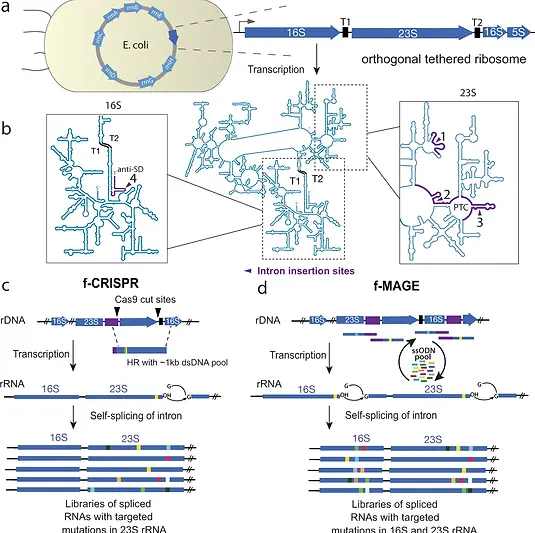
The ribosome is a highly conserved molecular machine whose sequence and structure constrain the chemistry of biological protein synthesis. During my doctoral research, I developed methods to engineer orthogonal tethered ribosomes in vivo for their continuous editing without modifying native ribosomal operons. The challenge was that repetitive genetic elements are difficult to engineer because conventional genome-editing methods cannot readily distinguish a desired copy from other nearly identical genomic loci. This limitation is particularly important for ribosomal RNA genes, which occur in multiple highly homologous operons in bacterial genomes. In this work, we developed “filtered editing,” a genome-engineering strategy that introduces sequence-specific genetic addresses using self-splicing introns, enabling selective modification of one repetitive locus while leaving native copies unaltered. (Radford et al., 2022)
High-throughput nucleic-acid imaging and single-cell molecular phenotyping
Earlier in my research career, I developed nucleic-acid imaging technologies that linked RNA and protein measurements in single cells and worked with physicians and scientists to apply these methods to immunological and infectious-disease questions. I developed structurally programmed fluorescent probes that increased signal while maintaining background performance and contributed to FISH-Flow, a workflow for concurrent detection of mRNA and protein by fluorescence in situ hybridization and flow cytometry. These technologies supported high- throughput molecular phenotyping and established an interdisciplinary foundation spanning molecular biology, quantitative analysis, and instrumentation (Bushkin et al., 2015, Arrigucci et al., 2017, Radford et al., 2016).

Evolution of the ribosome's catalytic core for abiological chemistry
The ribosome is a highly conserved molecular machine whose sequence and structure constrain the chemistry of biological protein synthesis. During my doctoral research, I developed methods to engineer orthogonal tethered ribosomes in vivo for incorporation of monomers beyond L-α-amino acids. This involved synthesis of molecules to select for ribosomal incorporation of specified monomers, and development of positive and negative in vivo selections. These approaches are extendable to multiple monomer classes and can be used in conjunction with expanded genetic codes to expand translation beyond natural proteins.
